

Hello! I'm Mary Lia Reiter and I will be your instructor for Sociol 2309. Please take a few minutes to review this syllabus and explore this site for information about your upcoming class. You may save this website as an icon on your cell phone or tablet by clicking the share button and saving to your home screen so that you can access it at any time.
Introduction to the law as a social institution, including the origins of law and its relationship to other social institutions, social control, and social change.
This class is the first of two courses offered by the Sociology Department that delve into the connection between law and society. Law influences nearly everything we do. In this course, you will be introduced to the fundamental ways that sociologists look at the reciprocal relationship between the law and society. We will start with an introduction to legal theory, then move on to a description of the legal institutions in society – the courts, the legislatures, and administrative agencies. You will learn about legal training and the legal profession, and the law as a tool for dispute resolution. social change, and (in)equality. We will end with a look at how the law influences privacy, surveillance, and technology in modern society.
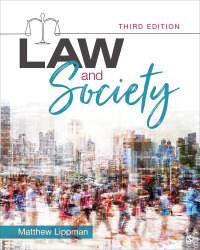
Lippman, Matthew. 2020. Law and Society. 3rd ed. Sage Publishers
ISBN 9781544392585
VitalSource E-book Link
Bookfinder Link
Additional readings will be available in Canvas
By the end of this semester, you should be able to:
This course is asynchronous/online.
There will be optional Zoom sessions announced each week. You will have readings and homework assignments available online in Canvas.
This course is divided into modules that will take approximately 1 week to cover. Some weeks, we will cover two modules.
This is a 3-credit-hour course. In the 8-week summer session, that means you should expect around 6 hours per week of time spent on direct instruction in addition to 12 hours of homework (reading and assignment preparation, for example) to receive a grade of (C) average.
You will complete a total of five (5) homework assignments during the semester. These assignments are worth 40 points each. They are located within your chapter modules and are submitted via Canvas. There are a total of 8 homework assignments available from which to choose. Choose the five that are the most interesting to you. There may be additional reading assignments or videos to watch associated with these homework assignments. They should take you around 1 - 3 hours to complete. If you complete all the homework assignments, your lowest three grades will be dropped. Completing more than the required number of homework assignments will not earn additional points towards your final grade. You can access the assignment, complete part of it, and save your work for later.
You will complete a short chapter quiz each week over each of the chapters assigned during that week. These quizzes are intended to encourage you to read and study your textbook. You may use your book while working on these quizzes, and you may submit the assignment up to three times prior to the due date. Your highest score will be recorded for grading purposes. There are 12 quizzes worth 30 points each.
You will participate in a recursive discussion board four times during the semester. Generally, I will start with a question, and the first student to post will answer that question than ask another question for the next student, who will then do the same, and so on, etc. There is no makeup for missing a discussion board deadline. There are 4 discussion boards worth 10 points each.
There will be two exams covering lectures, readings and any other class material. The format of the exams may include multiple choice, matching, fill-in the blank, and short answer/essay. The exams are not cumulative; however, an understanding of earlier concepts will be necessary to fully understand later topics covered in class. You will take the exams using Proctorio. Please make sure you have the technology necessary to use that tool.
5 at 40 points each
200 points total
20% of your grade
12 at 30 points each
360 points total
36% of your grade
4 at 10 points each
40 points total
4% of your grade
2 at 200 points each
400 points total
40% of your grade
This syllabus is © 2023, Reiter. All rights reserved.